

 By
By The debate around legal assistant vs paralegal has become increasingly important as law firms, corporations, and government agencies continue to expand their legal support teams. For law students, pre-law students, and early-career professionals, understanding legal assistant vs paralegal distinctions can help shape smarter career decisions. While both roles support attorneys and contribute to efficient legal operations, they differ in responsibility levels, training expectations, and advancement opportunities. A clear understanding of legal assistant vs paralegal responsibilities can help aspiring legal professionals choose the path that aligns with their skills, interests, and long-term career goals in a competitive legal marketplace.
What Is Legal Assistant vs Paralegal? Overview
The phrase legal assistant vs paralegal refers to the comparison between two legal support roles that are often confused. A legal assistant typically performs administrative and organizational tasks that help a law office function smoothly. A paralegal, on the other hand, generally performs substantive legal work under attorney supervision.
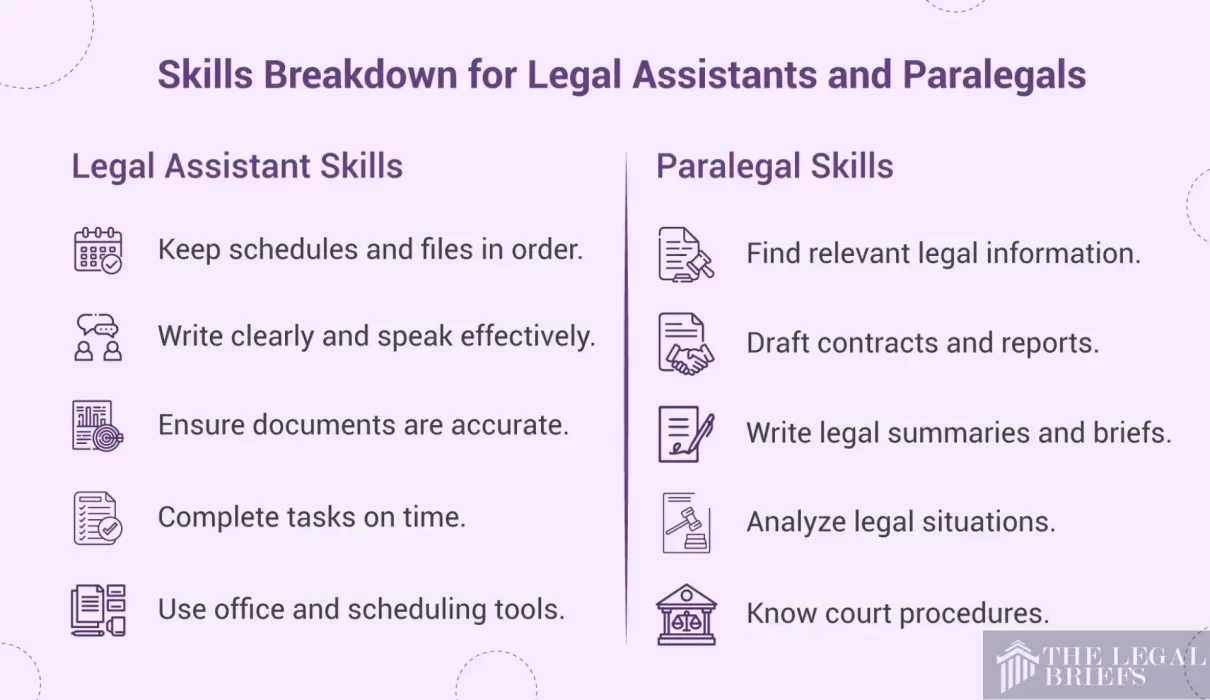
When evaluating legal assistant vs paralegal, it is important to understand that job titles sometimes overlap depending on the employer. Some firms use the terms interchangeably, while others maintain clear distinctions. In most modern legal workplaces, paralegals are expected to conduct legal research, draft documents, and assist with case preparation, while legal assistants focus more on scheduling, correspondence, file management, and client communication.
Key Fact: According to labor market data, legal support occupations continue to show demand as law firms seek cost-effective ways to deliver legal services while maintaining efficiency.
Key Responsibilities: Legal Assistant vs Paralegal
The comparison of legal assistant vs paralegal becomes clearer when examining daily responsibilities.
| Responsibility | Description |
|---|---|
| Client Communication | Answer client inquiries, schedule appointments, and maintain communication records. |
| Document Management | Organize files, pleadings, contracts, and case materials. |
| Calendar Coordination | Track court deadlines, meetings, hearings, and attorney schedules. |
| Legal Research | Typically performed by paralegals to support attorneys on legal issues. |
| Drafting Documents | Prepare correspondence, forms, pleadings, and legal memoranda. |
| Case Preparation | Assist attorneys with discovery, exhibits, and trial preparation. |
| Administrative Support | Handle office procedures, billing records, and file maintenance. |
| Compliance Tracking | Monitor deadlines and procedural requirements in legal matters. |
When discussing legal assistant vs paralegal, the most significant distinction is that paralegals often perform substantive legal work, while legal assistants primarily provide administrative support.
Education and Qualifications Required
Understanding educational requirements is essential when comparing legal assistant vs paralegal career options.
| Qualification | Details | Time Required |
|---|---|---|
| High School Diploma | Minimum requirement for some entry-level legal assistant positions. | 4 years |
| Associate Degree | Common pathway into legal support careers. | 2 years |
| Bachelor’s Degree | Preferred by some employers, especially larger organizations. | 4 years |
| Paralegal Certificate | Specialized legal training for aspiring paralegals. | 6–18 months |
| Internship Experience | Provides practical exposure to legal work environments. | Varies |
| Professional Certification | Voluntary credentials that strengthen resumes. | Several months |
For many employers evaluating legal assistant vs paralegal candidates, practical experience can be nearly as valuable as formal education. However, paralegal positions generally require more specialized legal training.
Salary and Earning Potential
One of the most important aspects of legal assistant vs paralegal comparisons involves compensation.
| Level | Average Salary (US) | Notes |
|---|---|---|
| Entry Level | $40,000–$50,000 | Common for new legal assistants and junior paralegals. |
| Mid-Level | $55,000–$70,000 | Increased responsibility and specialization. |
| Senior Level | $75,000–$95,000 | Experienced professionals managing complex matters. |
| Principal/Management Level | $100,000+ | Senior paralegals, legal operations managers, or supervisory roles. |
Salary differences in legal assistant vs paralegal positions often reflect the complexity of assigned work. Paralegals frequently earn higher compensation because they contribute directly to substantive legal tasks that support case strategy and client matters.
For current salary trends, students should review data published by the U.S. Bureau of Labor Statistics and reputable employment platforms.
Also Read: Paralegal Salary by State in 2026: Which States Pay the Most?
Real-World Profile
A practical example helps illustrate legal assistant vs paralegal responsibilities in action.
Sarah Martinez works at a mid-sized litigation firm as a paralegal. Her day begins by reviewing upcoming deadlines and preparing materials for attorney meetings. She conducts legal research, drafts discovery responses, and organizes evidence for active cases. Throughout the afternoon, she communicates with clients, coordinates with court personnel, and assists attorneys in preparing for depositions.
Across the hall, a legal assistant supports several attorneys by managing calendars, scheduling client consultations, maintaining case files, and processing correspondence. Both professionals play critical roles, but the legal assistant vs paralegal distinction becomes evident in the type of work each performs. Sarah’s tasks involve substantive legal support, while the legal assistant focuses on administrative efficiency and workflow management.
Pros and Cons
Evaluating legal assistant vs paralegal opportunities requires considering both advantages and challenges.
| Pros | Cons |
|---|---|
| Strong demand in legal settings | High workload during busy periods |
| Opportunity to learn legal procedures | Tight court and filing deadlines |
| Valuable entry point into law careers | Repetitive administrative tasks in some roles |
| Potential career advancement | Long hours in certain practice areas |
| Exposure to attorneys and clients | Stress associated with case management |
When considering legal assistant vs paralegal options, personal interests often determine which role feels more rewarding. Individuals who enjoy legal analysis may prefer paralegal work, while those who excel at organization may thrive as legal assistants.
How to Get Started: Legal Assistant vs Paralegal Career Path
If you are exploring legal assistant vs paralegal opportunities, follow these practical steps:
- Research Both Roles
Study job descriptions to understand how employers define legal assistant and paralegal responsibilities. - Assess Your Interests
Determine whether you prefer administrative coordination or substantive legal work. - Pursue Relevant Education
Complete an associate degree, bachelor’s degree, or paralegal certificate program. - Gain Practical Experience
Seek internships, clerkships, or entry-level legal office positions. - Develop Technical Skills
Learn legal research tools, document management software, and case management platforms. - Build Professional Connections
Network with attorneys, paralegals, professors, and legal recruiters. - Apply Strategically
Tailor your resume based on whether you are pursuing a legal assistant or paralegal role.
💡 Insider Tip: When comparing legal assistant vs paralegal career paths, focus on the daily work rather than the title alone. Employers sometimes use different terminology, so reviewing actual responsibilities is essential.
Top Skills You Need to Succeed
Success in legal assistant vs paralegal roles depends on developing a combination of technical and professional skills.
- Legal Research: Essential for locating statutes, regulations, and case law.
- Written Communication: Strong writing improves document accuracy and professionalism.
- Organization: Legal matters involve extensive records and strict deadlines.
- Attention to Detail: Small errors can affect filings and client matters.
- Time Management: Legal professionals often juggle multiple cases simultaneously.
- Technology Proficiency: Familiarity with legal software improves efficiency.
- Client Service: Professional interactions help build trust and credibility.
- Critical Thinking: Analytical skills support effective problem-solving in legal environments.
Whether examining legal assistant vs paralegal responsibilities or planning long-term advancement, these competencies remain highly valuable.
Conclusion
Choosing between legal assistant vs paralegal career paths requires understanding the differences in duties, education, compensation, and long-term opportunities. Both roles offer meaningful entry points into the legal profession and provide valuable exposure to legal practice. Students and early-career professionals should evaluate their strengths, career goals, and preferred work style before making a decision. For additional guidance, explore related resources on legal careers, paralegal education, and professional development within the legal industry.
Frequently Asked Questions
Is legal assistant vs paralegal the same thing?
No. Although some employers use the terms interchangeably, legal assistant vs paralegal distinctions often involve differences in substantive legal work, training requirements, and responsibility levels.
Which role earns more, a legal assistant or a paralegal?
In many markets, paralegals earn higher salaries because they perform more substantive legal tasks and often possess specialized education.
Can a legal assistant become a paralegal?
Yes. Many legal assistants gain experience, complete additional education, and transition into paralegal positions.
Is a paralegal role a good preparation for law school?
Yes. Paralegal work provides exposure to legal research, case management, and attorney-client interactions that can be valuable before attending law school.
