

 By
By Quick Facts
| Detail | Information |
|---|---|
| Case name | State v. Jasbir Singh alias Billa and Kuljeet Singh alias Ranga |
| Also known as | Ranga Billa case, Geeta and Sanjay Chopra kidnapping case |
| Date of crime | August 26, 1978 |
| Location | New Delhi (Gole Dak Khana to the Delhi Ridge) |
| Victims | Geeta Chopra, 16, and Sanjay Chopra, 14 |
| Accused | Jasbir Singh (alias Billa) and Kuljeet Singh (alias Ranga) |
| Charges | Section 302/34 (murder), 365/363/34, 366/363/34, 376/34 (rape), Indian Penal Code; Section 27, Arms Act (Billa) — see Sections and Charges at a Glance below |
| Trial court verdict | Death sentence, 1979 |
| Delhi High Court | Upheld sentence, November 16, 1979 |
| Supreme Court | Upheld sentence, April 21, 1981 |
| Execution | January 31, 1982, Tihar Jail |
| Legacy | Kirti Chakra awarded to victims; Sanjay Chopra Award and Geeta Chopra Award instituted for child bravery |
This article is for informational and educational purposes. It is not legal advice. Readers with questions about criminal procedure, capital sentencing, or related Indian law should speak with a licensed advocate.
Why the Ranga Billa Case Story Still Matters
Anyone researching the ranga billa case story is really researching a turning point in how Delhi thought about public safety, policing, and criminal justice. The case, formally recorded as State v. Jasbir Singh alias Billa and Kuljeet Singh alias Ranga and widely covered in reference sources such as Wikipedia’s entry on the case, involved the kidnapping and murder of two teenage siblings, Geeta and Sanjay Chopra, by Jasbir Singh, known as Billa, and Kuljeet Singh, known as Ranga. The crime took place in August 1978 and ended with both men being hanged in Tihar Jail in January 1982.
What makes the ranga billa case story more than a true crime footnote is the trail it left in Indian law. The trial produced a Delhi High Court judgment that is still cited in discussions of circumstantial evidence and the death penalty. A related petition from journalist Prabha Dutt led to a Supreme Court ruling on prisoners’ right to be interviewed by the press, a decision still referenced in media law. The case also shaped policing procedure around jurisdiction, since one of the earliest failures in the investigation was a dispute over which police station should act on a witness report, a lapse examined in detail in ThePrint’s 2026 retrospective on the case.
This piece walks through the ranga billa case story from the evening of the abduction to the execution, and explains the legal proceedings that followed at each stage.
The Chopra Family and the Evening of August 26, 1978
Geeta Chopra was sixteen years old and a second-year student at Jesus and Mary College in New Delhi. Her younger brother Sanjay was fourteen and studied at Modern School. Their father, Madan Mohan Chopra, was a captain in the Indian Navy. The family lived in the Officers’ Enclave in Dhaula Kuan.
On the evening of August 26, 1978, Geeta and Sanjay left home to take part in a youth radio programme called Yuva Vani, broadcast by All India Radio. They were expected at the radio station on Sansad Marg by 7 pm, and their father planned to collect them from the same spot at 9 pm once the broadcast ended.
The siblings left home around 6:15 pm. It began to drizzle, and a passerby gave them a lift part of the way toward the radio station. Around 6:30 pm, a mustard-coloured Fiat car stopped near them at Gole Dak Khana. What happened next set off a chain of events that would grip the country for years.
Witnesses Who Tried to Help
Several bystanders noticed the struggle inside the car that evening and tried to intervene, a detail that later became central to reconstructing the timeline in court. A man riding a scooter heard cries from inside the mustard Fiat and saw a girl pulling at the driver’s hair while a boy fought with the passenger. He could not stop the vehicle before it sped off toward Willingdon Hospital, but he reported the registration number to the police control room. Due to a transcription error at the control room, the plate number was recorded incorrectly, which slowed the response.
A second witness, a junior engineer with the Delhi Development Authority, spotted the same car further along the route. He rode up alongside it and saw the boy, bleeding from a shoulder wound, pleading for help through the window. He followed the car until it ran a red light and got away. He reported the correct registration number to the police, but the report went to a station that argued the matter fell outside its jurisdiction.
By 8 pm, when the Chopra parents tuned in to hear their children on the radio, a different voice was on air. Their father went to the radio station at 8:45 pm and learned Geeta and Sanjay had never arrived. He spent the rest of the night searching hospitals and police stations before formally reporting them missing.
Discovery of the Bodies
Two days later, on August 28, 1978, a cowherd grazing cattle in the Delhi Ridge forest area near Buddha Jayanti Park found the bodies of the two siblings. Police were called to the scene, and the Chopra parents were brought in to identify their children.
The post-mortem, conducted the following day, found the bodies in an advanced state of decomposition. The examining doctor recorded multiple stab wounds on both victims and a fractured jaw on Geeta. Because of the state of decomposition, the medical examiner could not conclusively confirm sexual assault at that stage, though this point would be revisited during trial through confession statements and other evidence.
Captain Chopra took the case to the press. Newspapers carried photographs and appeals for information, and the Delhi Police announced a monetary reward. The case had, by this point, become a matter of intense public concern, and Prime Minister Morarji Desai reportedly took a personal interest in the investigation. The handling of the case became a political flashpoint, with the ruling Janata Party facing criticism over the initial delays.
Forensic Clues That Cracked the Case
The break in the investigation came from an unlikely source. On the night of the kidnapping, the two accused visited Willingdon Hospital because one of them had suffered a head injury during the struggle with the children. They gave false names and a fabricated account of how the injury occurred. A doctor ordered a skull X-ray, and in the process, one of the men left a fingerprint on the X-ray authorisation form.
Police at the hospital grew suspicious and asked the two men to accompany them to the location they claimed to have been attacked. No signs of a struggle were found there. The men were told to report back to the station the next morning. They never did, and the addresses they had provided turned out to be false.
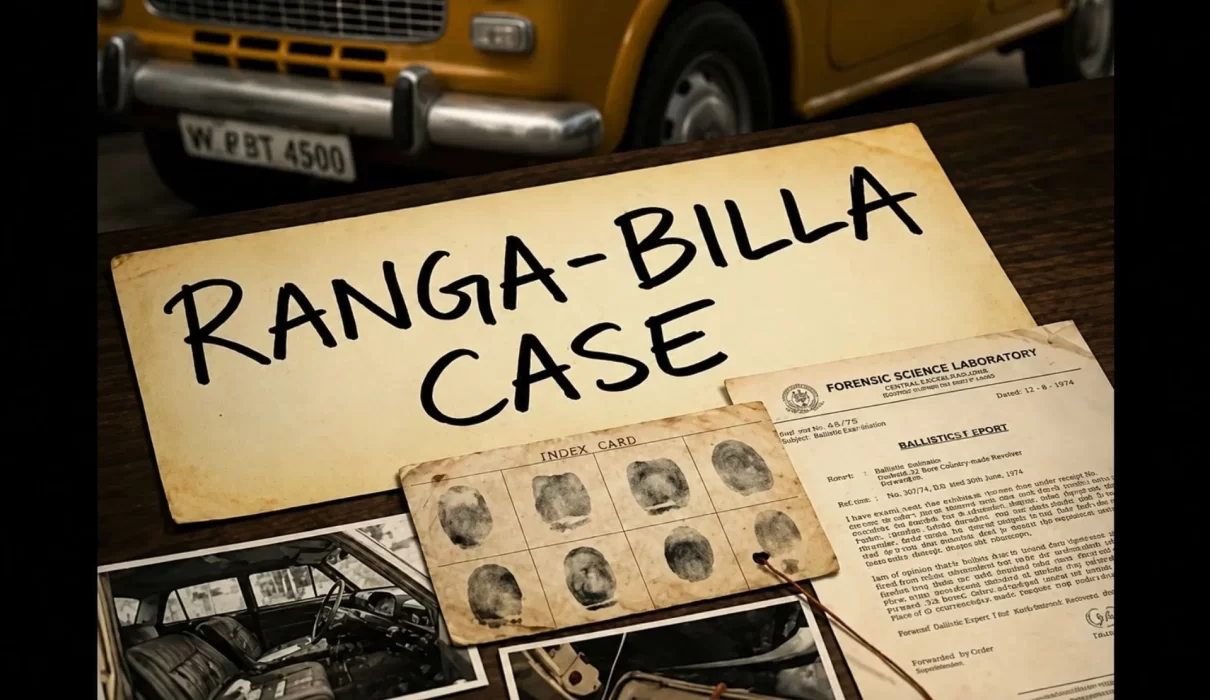
Investigators later recovered the abandoned Fiat in a different part of the city. Forensic examiners from the Central Forensic Science Laboratory found fingerprints, a cigarette butt, hair samples, and bloodstains inside the car. They also discovered multiple false number plates hidden in the vehicle, one of which had been painted over an earlier plate number. Soil samples from the car’s floor mat matched soil from the site where the bodies were discovered.
The Arrest on the Kalka Mail
Billa and Ranga evaded capture for nearly two weeks, moving between rented rooms in Delhi and Agra under false identities. Their arrest happened almost by chance. On September 8, 1978, they boarded the Kalka Mail train near Agra and entered a compartment reserved for military personnel. When asked to show identification, they could not, and a scuffle broke out with the soldiers present. One of the soldiers recognised the pair from a newspaper photograph that had been circulated as part of the police appeal.
The two men were handed over to the police the next day and held in separate, non-adjoining cells, a detail that later mattered in court because it supported the argument that their subsequent confessions had been made independently of each other.
A medical examination after arrest found bruises consistent with a recent scuffle and a head wound matching the timeline of the hospital visit weeks earlier. Fingerprint, blood, and hair samples were collected. When compared against evidence recovered from the car and the bodies, the forensic picture aligned closely with both men.
Confessions and the Case for the Prosecution
Both accused eventually gave confessional statements to a metropolitan magistrate, though both later retracted them, claiming coercion. Ranga confessed on September 22 and retracted the statement in November. Billa confessed on October 19 and retracted his statement about a week later. Because the two accounts had been recorded separately and the men had not had contact with each other in custody, prosecutors argued the statements corroborated one another on key facts even after the retractions.
The prosecution’s case, later accepted by the trial court and upheld on appeal, held that Billa and Ranga picked up Geeta and Sanjay after offering them a lift, then attempted to rob and later kill them once they learned their father was a naval officer. The prosecution argued this realisation changed the calculation for the accused, since they assumed a Navy officer’s family would not offer a large ransom and could pose a danger if the children were released.
The evidence at trial connected the two men to the crime through physical evidence rather than the confessions alone. Hair recovered from the car and from one victim’s body matched Ranga. Fingerprints inside the car matched his prints. Bloodstains on his clothing matched the blood group of the victims. Separately, hair recovered from the other victim matched Billa, and his signature at the hospital matched the sample taken after arrest. The X-ray taken on the night of the crime matched a follow-up X-ray taken after his arrest.
Trial Court Verdict and the Death Sentence
Jasbir Singh and Kuljeet Singh were convicted of murder under Section 302 of the Indian Penal Code, read with Section 34 for common intention, along with kidnapping and rape-related offences under Sections 363, 365, 366, and 376. An additional sessions judge in Delhi sentenced both men to death. The full section-by-section breakdown, including a note on a common discrepancy in secondary sources, is set out in the table below.
The trial court found that the killings were not a spontaneous act during a robbery gone wrong, but a calculated decision made once the accused realised who the children’s father was. This finding became central to the sentencing, since Indian courts reserve the death penalty for cases that meet a heightened threshold of culpability.
Sections and Charges at a Glance
Different secondary sources list slightly different Indian Penal Code sections for the Ranga Billa case story, so it is worth pinning down what the primary judgment text actually says. According to the Delhi High Court’s own 1979 order, the conviction and sentencing broke down as follows.
| Section | Offence | Sentence |
|---|---|---|
| 302 read with 34, IPC | Murder, common intention | Death |
| 365/363 read with 34, IPC | Kidnapping with unlawful confinement | 5 years rigorous imprisonment |
| 366/363 read with 34, IPC | Kidnapping a woman to compel marriage or force intercourse | 5 years rigorous imprisonment |
| 376 read with 34, IPC | Rape | 7 years rigorous imprisonment |
| 27, Arms Act, 1959 | Illegal possession of arms (Billa only) | 1 year rigorous imprisonment |
All sentences ran concurrently, which had no practical effect once the death sentence was confirmed. Readers will notice that some secondary summaries, including certain encyclopaedia-style entries, list Section 367 in place of Section 376. The Delhi High Court judgment itself is the more authoritative source on this point, and it records the rape conviction under Section 376, not Section 367. This is a useful reminder for anyone researching the ranga billa case story to go back to the original judgment text rather than relying solely on summaries, including this one, for exact statutory citations.
How the Ranga Billa Case Compares to the “Rarest of Rare” Doctrine
Readers researching Indian death penalty law often land on the ranga billa case story alongside one other case: Bachan Singh v. State of Punjab, decided by a five-judge Constitution Bench of the Supreme Court on May 9, 1980, roughly six months after the Delhi High Court confirmed the death sentences against Billa and Ranga. Bachan Singh is the case that formally established the “rarest of rare” doctrine, holding that the death penalty under Section 302 could survive constitutional scrutiny only if courts reserved it for cases where a lesser sentence would clearly fail to meet the ends of justice.
The two cases are often read together because the Ranga Billa appeals were moving through the appellate system in the same period, and the final Supreme Court rulings in Kuljeet Singh v. Union of India leaned on similar reasoning: that the crime was planned rather than impulsive, that the accused showed no remorse, and that the nature of the offence left the court with no real sentencing alternative. Later commentary on Indian capital sentencing frequently cites the Ranga Billa case story as a practical illustration of what “rarest of rare” was understood to mean in the years immediately following the Bachan Singh doctrine, even though the Ranga Billa trial and High Court judgment predate the doctrine’s formal articulation.
The Batched Clemency Ruling of January 1982
One detail that often gets lost in shorter retellings of the ranga billa case story is that the final Supreme Court order upholding the sentences, decided on January 20, 1982, just eleven days before the execution, was not a standalone ruling on the Chopra case. The judgment in Kuljeet Singh alias Ranga v. Lt. Governor of Delhi was delivered together with related clemency petitions from other death-row prisoners represented in the same batch of hearings, which is why the reported order also lists counsel appearing on behalf of the State of Karnataka and an unrelated intervener.
This matters for readers trying to understand how India’s clemency process worked in practice during this period. The Supreme Court used the occasion to lay down general observations on the scope of presidential clemency power under Article 72, reasoning that applied beyond the Chopra case alone. Anyone citing this judgment for its discussion of clemency powers, rather than for its facts, should be aware it was written to resolve more than one prisoner’s petition at once.
Appeals to the Delhi High Court and Supreme Court
Billa and Ranga challenged their conviction and sentence before the Delhi High Court. On November 16, 1979, the High Court upheld both the conviction and the death sentence, describing the two men in strong terms as having shown no hesitation in taking the children’s lives once they perceived a risk to themselves.
The convicts then filed a special leave petition before the Supreme Court of India under Article 136 of the Constitution. That petition was dismissed. They subsequently petitioned the President of India for clemency under Article 72, which allows the President to pardon, reprieve, or commute a sentence. The President rejected the plea without providing detailed reasons, prompting a further petition to the Supreme Court arguing that clemency powers should be exercised with due consideration.
On April 21, 1981, the Supreme Court upheld the death sentences a second time. The repeated rounds of appeal and clemency petitions extended the case by several years beyond the original conviction, a pattern that later became common in India’s long-running debate over delays in capital cases.
The Press Interview Case: Prabha Dutt v. Union of India
One of the lesser-known but legally significant offshoots of the ranga billa case story involves the media, not the crime itself. After the Supreme Court upheld the sentences, several journalists sought permission to interview Billa and Ranga on death row. Tihar Jail authorities refused, citing prison rules that limited visits to relatives, friends, and legal advisers.
Journalist Prabha Dutt of the Hindustan Times challenged this refusal in the Supreme Court. On November 7, 1981, the Court ruled that the convicts could be interviewed by journalists if the prisoners themselves were willing to speak. The ruling, Prabha Dutt v. Union of India (full text also available via the Supreme Court’s own judgment archive), is still cited in Indian media law discussions of press access to prisoners and is treated as an early recognition of press freedom interests in the context of incarcerated individuals.
Acting on the ruling, five journalists were permitted to interview the two men together, for one hour, on January 30, 1982, the day before the execution. Billa agreed to speak and maintained his innocence. Ranga declined to be interviewed.
Judges and Lawyers Who Handled the Ranga Billa Case
The ranga billa case story passed through four separate reported judgments across three courts, each with its own bench and counsel on record. The names below come from the published case reports rather than news coverage, since court records are the more reliable source for this level of detail.
Trial court. Billa and Ranga were convicted and sentenced to death by an Additional Sessions Judge in Delhi. The published High Court and Supreme Court judgments in this case refer to the trial judge only by designation, not by name, so the individual judge’s identity is not reliably confirmed in the public case reports this article draws on.
Delhi High Court, November 16, 1979. The appeal, registered as Murder Reference No. 1 of 1979 along with Criminal Appeals 108, 109, and 110 of 1979 (full judgment text), was heard by a Division Bench of Justice V.D. Misra and Justice F.S. Gill. Justice Misra authored the judgment. The appellants were represented by a team of counsel that included K.K. Sud, B.D. Batra, Arvind Goel, K.T. Harindranath, V.J. Francis, and R.C. Kaushik, with both Billa and Ranga also making submissions on their own behalf.
Supreme Court, Special Leave Petition, December 8, 1980. The first round of Supreme Court appeal, Special Leave Petitions 562 and 1739 of 1980, was dismissed by a three-judge bench of Chief Justice Y.V. Chandrachud, Justice O. Chinnappa Reddy, and Justice Baharul Islam.
Supreme Court, Kuljeet Singh alias Ranga v. Union of India, April 21, 1981. This writ petition (full judgment text), filed under Article 32 to challenge the death sentence itself, was heard by Chief Justice Y.V. Chandrachud and Justice A.P. Sen, with the judgment delivered by Chandrachud. Senior Advocate R.K. Garg, with D.K. Garg and R.C. Kaushik, appeared for Ranga. M.K. Banerjee, Additional Solicitor General, with A. Subhashini, appeared for the Union of India. N.C. Talukdar, Senior Advocate, with R.N. Poddar, appeared for the Delhi Administration.
Supreme Court, Kuljeet Singh alias Ranga v. Lt. Governor of Delhi, January 20, 1982. A second and final clemency-related writ petition (full judgment text), decided just days before the execution, was heard by a three-judge bench of Chief Justice Y.V. Chandrachud, Justice O. Chinnappa Reddy, and Justice A.P. Sen. This case was heard together with related clemency petitions from other death-row prisoners, which is why the reported judgment also lists counsel appearing for the State of Karnataka and other parties unconnected to the Chopra case itself. Billa was represented by counsel named Jain along with P.K. Jain. N.C. Talukdar and R.N. Poddar again appeared for the Delhi Administration. The Union of India was represented by Attorney General L.N. Sinha and Solicitor General K. Parasaran, along with Additional Solicitor General M.K. Banerjee and Advocate A. Subhashini. Notably, the bench record for this batched hearing also lists Advocate Raju Ramachandran, appearing for an unrelated intervener in the combined proceeding. Ramachandran, now a senior advocate and former Additional Solicitor General, later spoke publicly about how closely the Chopra case affected his own generation of Delhi lawyers, having grown up near Buddha Jayanti Park where the bodies were found.
Supreme Court, Prabha Dutt v. Union of India, November 7, 1981. The separate press-access case was heard by a three-judge bench of Chief Justice Y.V. Chandrachud, Justice A.P. Sen, and Justice Baharul Islam, with the judgment delivered by Chandrachud. P.N. Lekhi and K.C. Dua appeared for the journalists seeking permission to interview the convicts, with additional applications made in person and through counsel by representatives of the Times of India, the United News of India, and the Press Trust of India.
Investigating officer. The police investigation was led by Inspector V.P. Gupta, who took custody of Billa and Ranga from army personnel at New Delhi railway station following their arrest and is credited with piecing together the forensic case that led to conviction, a role described in first-hand accounts gathered in ThePrint’s 2026 feature on the case.
The Execution
Jasbir Singh and Kuljeet Singh were hanged at Tihar Jail on January 31, 1982, roughly three and a half years after the crime and just over two years after the Delhi High Court upheld their sentences. Accounts from jail officials present at the time describe Billa as composed in his final moments, while Ranga resisted going to the gallows. Neither body was claimed by relatives.
Legacy of the Ranga Billa Case Story
The case left a lasting mark on Indian public life in several ways beyond the courtroom.
Geeta and Sanjay Chopra were posthumously awarded the Kirti Chakra, one of India’s highest peacetime gallantry honours, in recognition of their resistance during the attack. In 1978, the Indian Council for Child Welfare instituted two new bravery honours in their names, the Sanjay Chopra Award and the Geeta Chopra Award, given annually alongside the National Bravery Awards to children under sixteen who show similar courage.
The case also became a fixture of Indian police training and criminal law study, frequently cited as an early example of a conviction built substantially on forensic and circumstantial evidence rather than eyewitness testimony to the killings themselves. The investigation’s early stumbles, particularly the jurisdictional dispute that delayed the police response to witness reports, are still referenced in discussions of policing reform.
Public reaction to the case is also credited with influencing the political climate of the period, with the Janata Party facing criticism over its handling of the investigation ahead of subsequent elections.
The case has been revisited repeatedly in Indian popular culture, including two episodes of the television series Crime Patrol in 2018, the 1998 series Bhanwar, the 2025 Netflix series Black Warrant, and the 2026 Amazon Prime Video series Raakh, each drawing loosely on the events of 1978.
Key Legal Takeaways from the Ranga Billa Case
The ranga billa case story is frequently taught alongside a small number of principles that came out of the trial and appeals.
Courts can and do convict based primarily on forensic and circumstantial evidence when that evidence forms a coherent chain, even where confessions are later retracted. The corroborated physical evidence, including fingerprints, blood grouping, hair samples, and the X-ray identification, carried more weight at trial than the confessions themselves.
Retracted confessions are not automatically excluded from consideration, though courts weigh them carefully and generally look for independent corroboration, which is exactly what happened when the two separately recorded and later retracted statements were found to align with each other and with physical evidence.
Death penalty appeals in India can move through multiple stages, including the High Court, the Supreme Court under Article 136, a presidential clemency petition under Article 72, and a further Supreme Court challenge to how that clemency decision was made. The ranga billa case story shows this full sequence playing out within a period of roughly four years.
Press access to prisoners, including those on death row, is not absolute but can be judicially recognised where the prisoner consents, a principle established directly out of this case in Prabha Dutt v. Union of India.
The Ranga Billa case story is also a recurring reference point whenever a new case triggers similar levels of public outrage. Commentators frequently draw a direct line to the 2012 Delhi gang rape and murder case, noting that both cases produced comparable street protests, media scrutiny, and pressure on lawmakers, despite being separated by more than three decades.
Frequently Asked Questions
What is the Ranga Billa case?
Who were Ranga and Billa?
When were Ranga and Billa hanged?
What evidence led to the conviction of Ranga and Billa?
What was the outcome of the Ranga Billa case appeals?
Which judges heard the Ranga Billa case?
Who were the lawyers in the Ranga Billa case?
What is the connection between the Ranga Billa case and press freedom law?
Sources and Further Reading
This account draws primarily on the reported judgments and established reference sources listed below, rather than on secondary retellings, wherever the underlying court records were available.
- State v. Jasbir Singh alias Billa and Kuljeet Singh alias Ranga, Delhi High Court, November 16, 1979, full judgment text via Indian Kanoon
- Kuljeet Singh alias Ranga v. Union of India, Supreme Court of India, April 21, 1981
- Kuljeet Singh alias Ranga v. Lt. Governor of Delhi, Supreme Court of India, January 20, 1982
- Prabha Dutt v. Union of India, Supreme Court of India, November 7, 1981, and the official Supreme Court judgment archive copy
- Geeta and Sanjay Chopra kidnapping case, Wikipedia
- Billa-Ranga & a crime that changed Delhi, ThePrint, June 2026
- Bachan Singh v. State of Punjab case analysis, iPleaders
Readers who want to go deeper than a single article can also consult full-length treatments of the case, including Sudeep Chakravarti’s Fallen City: A Double Murder, Political Insanity, and Delhi’s Descent from Grace, and Sunil Gupta and Sunetra Choudhury’s Black Warrant, written by a former Tihar Jail superintendent who was present at the 1982 execution.
