

 By
By Legal citations are the backbone of professional legal writing. Whether you are drafting a law school memo, a moot court brief, or a law review article, every source you reference must be cited using a recognized format. For most U.S. law students, that format is the Bluebook.
Yet many first-year students find legal citation rules confusing, time-consuming, and easy to get wrong. The good news is that modern legal citation tools make the process significantly easier. This guide walks you through the Bluebook system, explains the most common citation formats, and reviews the top tools available to law students in 2026.
What Are Legal Citations and Why Do They Matter?
A legal citation is a standardized reference that identifies a specific legal source, such as a court case, statute, regulation, or law review article. Citations serve two core purposes in legal writing. First, they allow readers to locate the exact source you are referencing. Second, they demonstrate that your legal arguments are supported by recognized authority.
In the U.S. legal system, citation accuracy is taken seriously. Courts can and do reject briefs that fail to follow citation standards. Law professors deduct points for citation errors on legal writing assignments. In practice, incorrect citations can undermine a lawyer’s credibility with a judge.
What Is the Bluebook?
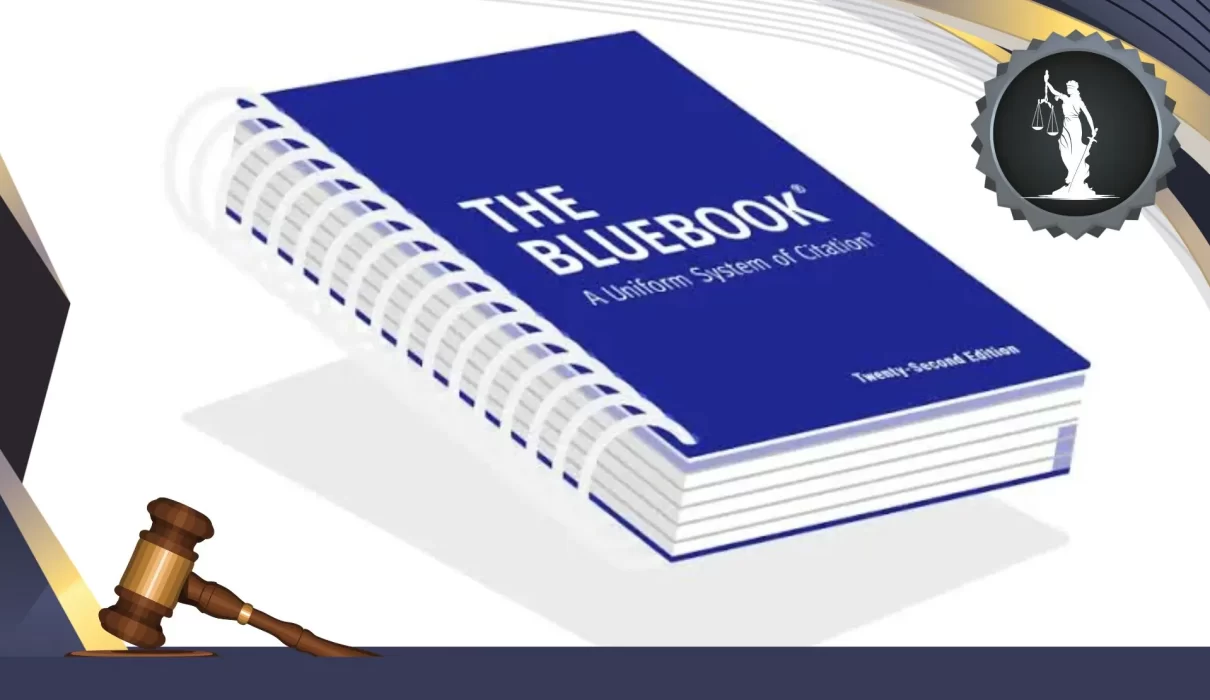
The Bluebook: A Uniform System of Citation is the dominant citation guide in American legal writing. First published in 1926, it is now in its 21st edition and is jointly produced by the law review editors at Harvard, Yale, Columbia, and the University of Pennsylvania.
The Bluebook covers citation formats for cases, statutes, regulations, constitutional provisions, law review articles, books, and international sources. It uses two main citation systems: the Whitepages system for law review footnotes and the Bluepages system for practitioners and legal briefs.
Most law schools require students to learn Bluebook citation in their first-year Legal Research and Writing courses. You can access the full guide at bluebooklaw.com.
Common Legal Citation Formats with Examples
Understanding the structure of a Bluebook citation is the fastest way to start using it correctly. Below are the most common source types and their formats.
Court Cases
The standard format for a U.S. Supreme Court case is:
Case Name, Volume U.S. Page (Year).
Example: Brown v. Board of Education, 347 U.S. 483 (1954).
For federal appellate court decisions, the format is:
Case Name, Volume F.3d Page (Circuit Year).
Example: United States v. Jones, 565 F.3d 630 (8th Cir. 2009).
Federal Statutes
The format for citing a federal statute from the United States Code is:
Title U.S.C. Section (Year).
Example: 42 U.S.C. Section 1983 (2018).
Federal Regulations
For Code of Federal Regulations citations:
Title C.F.R. Section (Year).
Example: 29 C.F.R. Section 1910.1200 (2023).
Law Review Articles
Author Name, Article Title, Volume Journal Abbreviation Page (Year).
Example: Richard Posner, The Problems of Jurisprudence, 105 Harv. L. Rev. 1 (1991).
These examples follow standard Bluepages format used in briefs and legal memos. You can verify citation formats against the Cornell Legal Information Institute at law.cornell.edu.
Types of Sources That Require Legal Citations
Legal writing draws from a wide variety of primary and secondary sources. Primary sources carry binding authority. Secondary sources provide analysis and persuasive context.
Primary sources include federal and state court decisions, the U.S. Constitution and state constitutions, federal and state statutes, and administrative regulations from agencies like the EPA or NLRB.
Secondary sources include law review articles, legal treatises and textbooks, restatements of the law, and legal encyclopedias such as Am. Jur. and C.J.S.
Each source type has its own Bluebook citation format. Beginners should study Bluebook tables and examples for each category they use in their writing.
Challenges Law Students Face with Legal Citation
Legal citation has a well-earned reputation for being difficult to master. The Bluebook itself is over 500 pages long. Even experienced lawyers occasionally make citation errors.
The most common challenges for beginners include:
Distinguishing between full citations and short-form citations. A full citation is used the first time you reference a source. A short form, such as “Id.” or a shortened case name, is used for subsequent references in the same document.
Knowing when to use “Id.” versus “supra” versus a short case name. These short-form rules confuse many students early in law school.
Correctly abbreviating court names, reporters, and journal titles. The Bluebook contains lengthy abbreviation tables that must be consulted carefully.
Formatting citations for non-traditional sources like websites, government documents, and international materials, which follow separate rules.
Regular practice and using reliable citation tools are the most effective ways to overcome these challenges.
Best Legal Citation Tools for Law Students in 2026
Several digital tools now automate or assist with legal citation formatting. Here are the most widely used options available to law students today.
Zotero
Zotero is a free, open-source reference management tool that works as a browser extension and desktop application. It allows you to save, organize, and cite sources directly from your research. While Zotero supports many citation styles, Bluebook formatting requires installing a custom citation style file. It is particularly useful for organizing large research projects and integrating citations into Word documents. Download it free at zotero.org.
LexisNexis
LexisNexis is a comprehensive legal research platform used by law firms, courts, and law schools. It includes built-in citation formatting tools that generate Bluebook citations for cases and statutes retrieved on the platform. Many law schools provide students with free LexisNexis access. The platform also includes Shepard’s Citations, a tool used to verify that a case is still good law and has not been overruled.
Westlaw
Westlaw, operated by Thomson Reuters, is the other dominant legal research platform. It includes KeyCite, a citation verification tool similar to Shepard’s. Westlaw also offers citation guides and formatting assistance integrated into its research interface. Like LexisNexis, most law schools provide students with free Westlaw access during their enrollment.
Bluebook Online
The official Bluebook website at legalbluebook.com offers a digital subscription to the full Bluebook guide. The online version includes a search function and interactive examples, making it easier to find specific citation rules than flipping through the print edition. A student subscription is available at a reduced cost compared to the print version.
Citation Machine (Law)
Citation Machine offers a free online citation generator that supports Bluebook format for basic source types. While it is less precise than LexisNexis or Westlaw for complex legal sources, it is a convenient starting point for simple citations. Always verify auto-generated citations against the Bluebook before submitting.
How to Build Strong Citation Habits in Law School
Developing accurate citation skills early in law school pays dividends throughout your legal career. Here are practical habits that experienced law students and attorneys recommend.
Start every research project by identifying the source type before writing the citation. Knowing whether you are citing a federal statute, a circuit court opinion, or a law review article tells you which Bluebook rule applies.
Keep a running citation list as you research, not after. Tracking sources in real time prevents the frustration of trying to reconstruct citations at the end of a writing project.
Use Westlaw or LexisNexis to retrieve citations directly from the platform rather than building them manually. These platforms format citations automatically for cases and statutes they host.
Cross-check every auto-generated citation against the Bluebook before submission. No tool is 100% accurate, and professors and judges notice errors.
Practice short-form citation rules separately. Students often master full citations but struggle with “Id.”, “supra”, and short case name formats, which appear constantly in real legal writing.
Free Bluebook Resources for Law Students
Several free resources are available to supplement the Bluebook itself.
The Cornell Legal Information Institute at law.cornell.edu provides free access to U.S. Code, federal regulations, and Supreme Court opinions, all formatted in ways that make citation straightforward.
Georgetown Law Library’s online citation guide provides a plain-English Bluebook overview for law students, covering the most commonly used citation types with examples.
Oyez.org offers case summaries and audio recordings of Supreme Court oral arguments. While not a citation tool, it is an excellent companion resource for case research that feeds into citations.
Your law school library’s reference staff is also an underused resource. Most law librarians are trained in legal citation and can help you work through complex citation questions.
Conclusion
Legal citation is a skill that every law student must develop, and the Bluebook is the standard they must learn. While the system is detailed and occasionally complex, modern citation tools make it far more manageable. Zotero, LexisNexis, Westlaw, and the official Bluebook Online platform all offer features that streamline formatting and reduce errors.
The key is to combine tool use with genuine understanding of the underlying citation rules. Tools help with speed and accuracy, but they do not replace the judgment needed to know which format applies in each situation.
Law students who invest time in mastering citation early in their studies are better prepared for law review, moot court, internships, and ultimately the demands of legal practice.
Legal Citation Tools: 2026 Updates Law Students Should Know
The legal citation landscape has shifted noticeably heading into 2026, with several developments affecting how law students research, cite, and verify legal sources.
Bluebook 21st Edition Remains the Standard
The 21st edition of the Bluebook, released in 2020, remains the current governing edition as of 2026. No new edition has been announced. However, the Bluebook Online platform has continued rolling out interface improvements, including faster rule search and better mobile access, making digital subscriptions more practical than the print version for everyday use.
AI Citation Assistants Are Now Embedded in Major Platforms
Both Westlaw and LexisNexis have integrated AI-assisted research features into their platforms in 2025 and 2026. Westlaw’s AI tool, built on Thomson Reuters’ legal AI infrastructure, now offers citation suggestions alongside case research results. LexisNexis has similarly expanded its AI research assistant, Lexis Plus AI, with improved citation generation for cases and statutes. While useful, legal professionals and professors continue to emphasize that AI-generated citations must always be manually verified.
Free Citation Access Through Law School Partnerships Has Expanded
Several law schools have expanded their partnerships with Westlaw and LexisNexis in 2025 to include post-graduation access periods, giving newly licensed attorneys continued access to citation tools during their first year of practice. Students should check with their law school library to confirm what access extends beyond graduation.
Cornell LII Remains the Top Free Legal Citation Resource
The Cornell Legal Information Institute continues to be the most relied-upon free resource for U.S. legal citations as of 2026. The platform updated its U.S. Code database with the most recent statutory amendments and continues to offer free access to Supreme Court opinions, federal regulations, and the full U.S. Constitution, all in formats that make Bluebook citation straightforward.
Citation Errors in AI-Drafted Briefs Are a Growing Judicial Concern
In 2023 and 2024, multiple cases made headlines when attorneys submitted AI-generated briefs containing fabricated case citations. By 2026, several federal courts have issued standing orders requiring attorneys to certify that all citations in filed documents have been independently verified. This development makes citation accuracy skills more important than ever for law students entering practice.
