


 By
By Legal industry trends in 2026 are moving faster than at any point in the past decade, driven almost entirely by one force: artificial intelligence. According to the 2026 Clio Legal Trends Report, AI adoption among legal professionals has climbed to 79%, up from just 19% three years earlier. That shift is reshaping how lawyers bill clients, how firms compete for work, and which practice areas are growing fastest.
This article breaks down the legal industry trends backed by current survey data from Clio, Thomson Reuters, and the Association of Corporate Counsel, so attorneys and firm leaders can see where the profession is actually heading rather than where commentators guess it might go.
Why Legal Industry Trends Matter for Law Firms Right Now
Tracking legal industry trends is no longer optional for firms that want to stay competitive. Clients increasingly expect technology-enabled service, predictable pricing, and faster turnaround, and firms that ignore these shifts risk losing work to competitors who adapt faster.
Three groups should pay close attention to these shifts this year: solo and small firm owners deciding where to invest limited resources, mid-sized firm partners managing growth, and in-house counsel evaluating outside firms on technology capability.
AI Adoption Is the Defining Legal Industry Trend of 2026
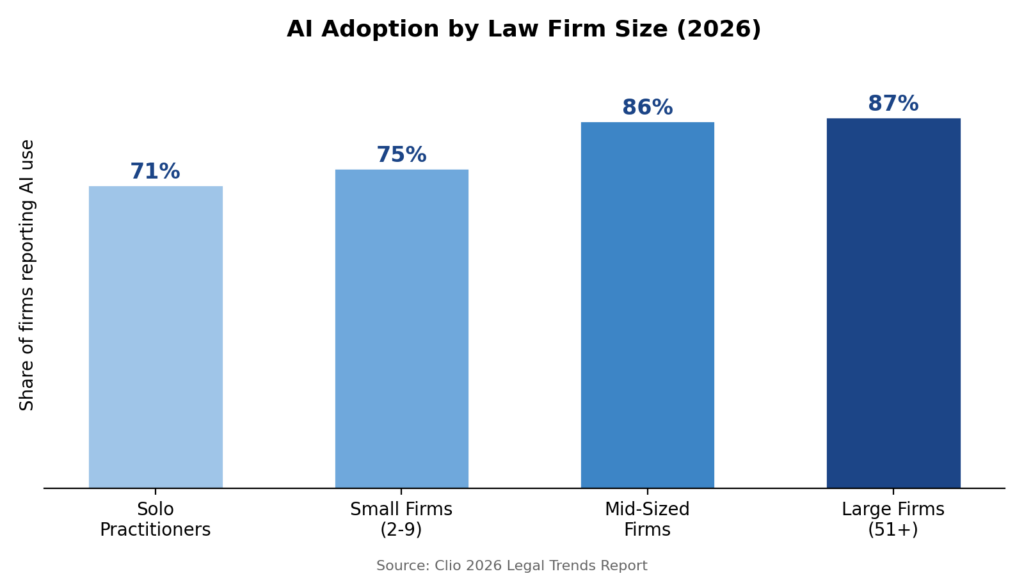
Artificial intelligence adoption is the single biggest legal industry trend shaping the profession this year. Clio’s 2026 data shows adoption now varies sharply by firm size: 71% of solo practitioners, 75% of small firms, 86% of mid-sized firms, and 87% of large firms report using AI in some capacity. The chart below shows this breakdown.
Despite high adoption, governance has not kept pace. More than half of legal professionals, 53%, say their firm has no formal AI policy or are unaware that one exists. That gap matters: firms using AI without clear guardrails face higher exposure to confidentiality breaches, inaccurate filings, and ethics complaints. The most common current uses are legal research, document review, and contract analysis, with Clio’s analysis estimating that up to 74% of traditionally billable tasks involving information gathering and data analysis could be automated.
Billing Models Are Shifting Because of AI
One of the clearest legal industry trends tied to AI adoption is the move away from pure hourly billing. As AI compresses the time needed for document review and research, charging strictly by the hour increasingly penalizes firms for becoming more efficient.
Clio reports that 59% of firms now use flat fees exclusively or alongside hourly billing, and client preference is pushing this further: 71% of clients say they would prefer a flat fee for an entire case. Firms that have not revisited their pricing model in the past two years are working against current legal industry trends rather than with them.
The AI Efficiency Paradox: Faster Work, Uneven Revenue
A counterintuitive trend worth watching closely is what researchers are calling the efficiency paradox. Despite record AI adoption among solo and small firms, only about a third report a corresponding revenue increase, 32% of solos and 31% of small firms, according to survey data compiled by the North Carolina Bar Association.
The reason traces back to pricing: 86% of solo firms and 78% of small firms have not adjusted their billing models to reflect AI-driven efficiency gains. In other words, firms are completing work faster but are still charging as if they were not. Adopting new technology and capturing its financial benefit are two separate steps, and the second step is where many firms are currently falling short.
Corporate Legal Departments Are Outpacing Outside Counsel
A less-discussed but significant legal industry trend is happening inside corporate legal departments rather than law firms. The ACC/Everlaw GenAI Survey found that in-house AI adoption more than doubled in a single year, from 23% to 52%. As a direct consequence, 64% of in-house teams now expect to rely less on outside counsel as they build comparable AI capability internally.
For law firms that serve corporate clients, this is one of the more urgent legal industry trends to address: 60% of in-house teams report they do not know whether their outside firms use generative AI on their matters, and that transparency gap is closing as clients begin to ask directly.
Cybersecurity and Data Privacy Expertise Is in Higher Demand
As firms and their clients store more data in cloud-based systems, demand for lawyers with cybersecurity and privacy expertise continues to climb. This shift is driven by the same forces pushing AI adoption: more digital case data, more cross-border data transfers, and tighter state and federal privacy requirements.
Lawyers advising on data breach response, regulatory compliance, and vendor risk are increasingly treated as essential members of a firm’s practice rather than specialists called in occasionally.
Alternative Legal Service Providers Continue to Expand
Outside the traditional law firm model, alternative legal service providers, companies that handle high-volume work such as contract management, e-discovery, and compliance support, continue gaining market share. This reflects the same efficiency and cost pressures reshaping billing: clients increasingly route routine, high-volume legal work to specialized providers rather than paying full law firm rates for it.
Specialization and Regulatory Complexity Are Increasing Together
As regulations affecting finance, employment, technology, and international trade continue to expand, legal work is becoming more specialized. Lawyers who build deep expertise in a narrow practice area, such as cybersecurity law, healthcare compliance, or cross-border data transfers, are positioned to capture more of the high-value work that AI cannot fully automate.
This pairing of regulatory complexity and specialization is one of the more durable shifts in the profession, since it has held steady across multiple years of survey data even as AI adoption accelerated.
What These Legal Industry Trends Mean for Your Firm in 2026
For firm leaders deciding where to act first, three steps stand out from this year’s data:
- Put a written AI use policy in place. More than half of firms currently have none, which is the single biggest governance gap in the data.
- Revisit billing structures before clients force the issue. Client preference has already shifted toward flat fees faster than most firms have adjusted pricing.
- Be ready to disclose AI use to corporate clients proactively. The transparency gap between firms and in-house teams is closing quickly.
Firms that treat these shifts as operational priorities, not background reading, are the ones most likely to convert efficiency gains into actual revenue growth.
About This Data
Figures in this article are drawn from the 2026 Clio Legal Trends Report, the Thomson Reuters 2026 AI in Professional Services Report, the ACC/Everlaw GenAI Survey, and survey data compiled by the North Carolina Bar Association. Where percentages differ slightly between sources due to different survey populations, the most recent and most directly sourced figure is used. This article was reviewed by The Legal Briefs editorial team for factual accuracy as of June 30, 2026, and will be updated as new survey data becomes available.
Frequently Asked Questions
What is the biggest legal industry trend in 2026?
Are law firms moving away from hourly billing?
Why are some firms not seeing revenue growth despite using AI?
How is AI affecting the relationship between corporations and outside law firms?
What should small law firms prioritize given current legal industry trends?
Key Takeaways
- AI adoption among legal professionals reached 79% in 2026, up from 19% in 2023
- Adoption varies by firm size: 71% solo, 75% small, 86% mid-sized, 87% large firms
- 53% of firms have no formal AI policy
- 59% of firms now use flat fees exclusively or alongside hourly billing
- Only about a third of solo and small firms report AI-linked revenue growth so far
- In-house legal AI adoption doubled from 23% to 52% in one year
- Cybersecurity, data privacy, and alternative legal service providers remain fast-growing practice areas
Sources
Clio. 2026 Legal Trends Report. Clio, 2026. | Thomson Reuters Institute. 2026 AI in Professional Services Report. Thomson Reuters, 2026. | Association of Corporate Counsel & Everlaw. GenAI Survey. ACC, 2026. | North Carolina Bar Association. By the Numbers: What Surveys Show About Law Firm AI Adoption. NCBA, 2026.
